
Email: sales@bondsil.com
Tel:+86 - 0755 2105 3189
Addr: H Building ,Xinwei The 3rd Industrial Park,Dalang Street,Longhua New District , Shenzhen City ,Guangdong Province ,China

What We Can Do When Get Bubbles in Your Silicone Overmolding PA66 Parts?
04 Jun 2026
Bubbles in silicone overmolded onto PA66 (nylon 66) parts are one of the most stubborn quality issues in the industry. Mold changes, temperature adjustments, extra venting — and the problem keeps coming back.
Here are the 2 root causes that account for the vast majority of these failures.
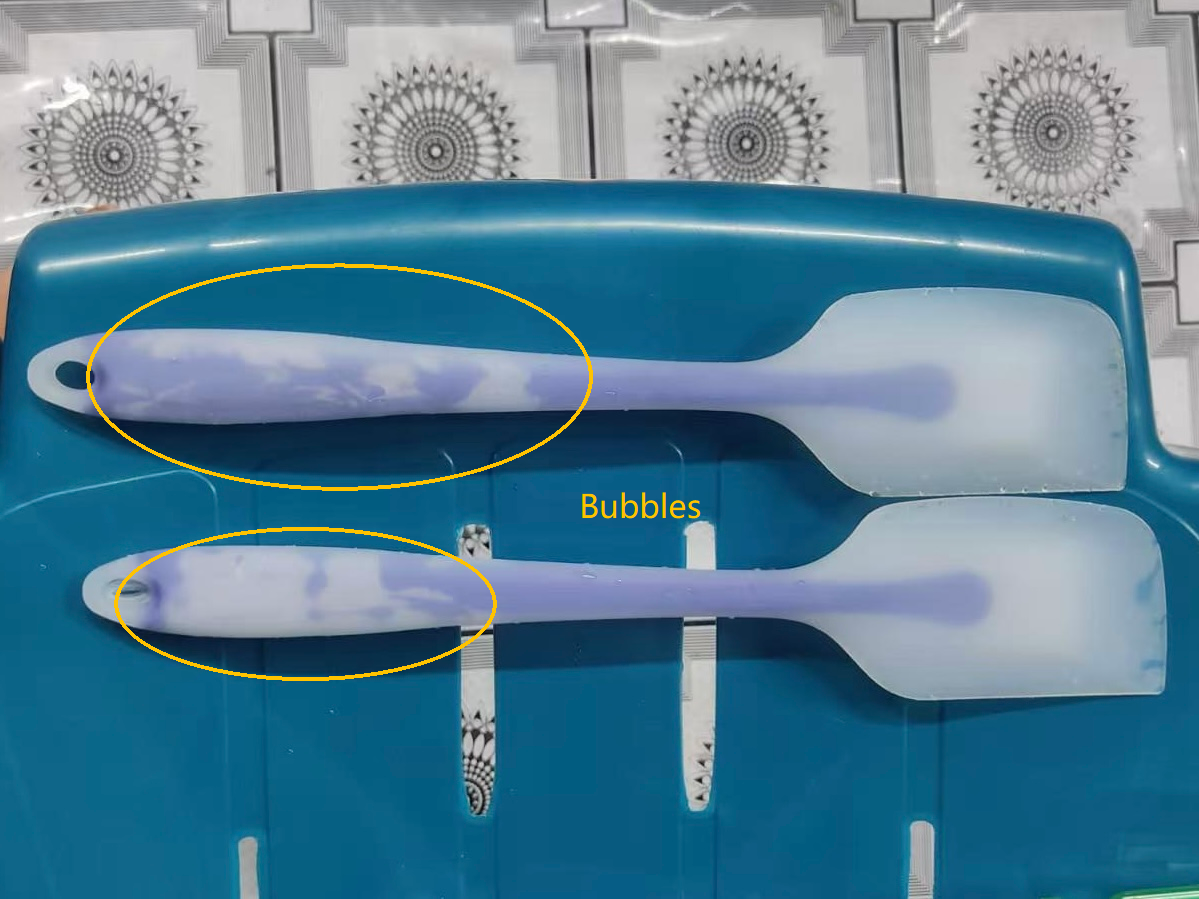
1. Wrong primer: the interface never truly bonds
Primer is the chemical bridge between silicone and nylon 66. Use the wrong one and the two materials can appear bonded on the surface while hiding a weak interface underneath. When vulcanization generates gas, that interface buckles — producing bubbles or delamination.
Suggestion:
Use a primer specifically formulated for silicone bonded to polar engineering plastics like PA66 (nylon 66) Our primer is engineered for exactly this combination with significantly improved bonding strength. We will provide different primers for different silicone systems.
Platinum system - CL-PA-AB
Peroxide system - CL-24C-3
How to use the primers?
① Surface cleaning: degrease the plastic after mechanical sandblasting or sandpaper polishing, or chemical treatment with alcohol.
② Applying: Apply to substrate by dipping, spraying, brushing.
③ Drying: Bake at 100-120℃ for 5-15 min.
④ Parking: As a general rule, usage time after primer treatment should not exceed 4 hours. Performance may be degraded after 4 hours or more.
⑤ Vulcanization: If use platinum curing agent, and the vulcanization should not exceed 140°C
2. Moisture in the nylon 66
Nylon 66 is highly hygroscopic. Left in open air for just a few hours, its moisture content climbs well above the safe threshold. During vulcanization, absorbed water flash-vaporizes and punches bubbles into the interface — regardless of how good your primer is.
Suggestion:
① In addition to cleaning the PA66 (nylon 66) surface, you can also bake it at 130 ℃ for 30min, then wait for it to cool to room temperature before applying the primer.
② Store dried PA66 (nylon 66) inserts in a clean environment and complete over-molding within 2 hours.
Watch out: a primer coat that is too thick traps solvent inside. The surface skins over while the interior stays wet — then during cure, that trapped solvent vaporizes and creates its own bubbles. Thin coat + full flash-off is non-negotiable.
Kanglibang -15 years of experience in silicone bonding, providing you with professional silicone solutions. Are you interested in a free primer sample and technical consultation? Please feel free to Contact Us.