
Email: sales@bondsil.com
Tel:+86 - 0755 2105 3189
Addr: H Building ,Xinwei The 3rd Industrial Park,Dalang Street,Longhua New District , Shenzhen City ,Guangdong Province ,China

Silicone Rubber Curing Agents – Platinum vs. Double 2,5 (Peroxide)
02 Jul 2026
I. Basic Concepts
1: What is a platinum curing agent?
Platinum curing agent is a two‑component addition‑cure system. It uses a platinum complex as the catalyst to crosslink silicone rubber via an addition reaction. It typically consists of Part A (platinum catalyst) and Part B (inhibitor). The curing process produces no by‑products, making it an environmentally friendly curing system.
2: What is Peroxide curing agent?
Double 2,5 curing agent (chemical name: 2,5‑dimethyl‑2,5‑di(tert‑butylperoxy)hexane) is an organic peroxide curing agent. It decomposes at high temperatures to generate free radicals, which initiate crosslinking of silicone rubber via a free‑radical reaction. During this process, by‑products such as water, methane, and acetone are formed. Double 2,5 is usually a translucent paste with a slight pungent odour.
II. Main Differences Between the Two
3: What are the core differences between platinum and Double 2,5 curing agents?
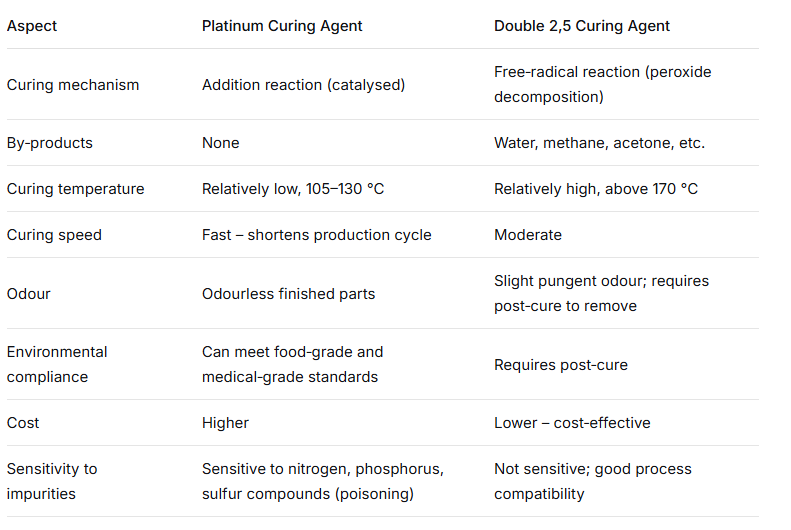
4: What are the advantages and disadvantages of each?
Platinum curing agent
• Advantages: Fast curing, odourless and non‑toxic products, high transparency, no blooming, high environmental compliance (can pass FDA, LFGB, etc.), excellent physical properties (tensile strength, tear strength, resilience), low shrinkage.
• Disadvantages: Higher cost, stricter handling requirements, susceptible to contamination and deactivation.
Double 2,5 curing agent
• Advantages: Lower cost, moderate curing speed, good scorch safety, suitable for carbon‑black‑filled compounds, wide application range, low compression set, high elongation.
• Disadvantages: Pungent odour, requires post‑cure, relatively poorer ageing resistance.
III. How to Choose
5: When should I choose a platinum curing agent?
Platinum curing agent is recommended for:
• Food‑contact or medical applications (e.g., baby bottle nipples, medical tubing, food‑grade seals)
• High transparency or demanding appearance (e.g., optical lenses, crystal‑clear parts)
• Strict environmental requirements (FDA, LFGB, RoHS, etc.)
• High‑performance needs (low compression set, excellent ageing resistance)
• One‑step curing without the need for post‑cure
6: When should I choose Double 2,5 curing agent?
Double 2,5 is suitable for:
• General industrial products with less stringent environmental and performance requirements
• Cost‑sensitive applications
• Compounds heavily filled with calcium carbonate, carbon black, etc.
• Thick‑section parts or blends with other materials
• Applications where odour and blooming are not critical
IV. Handling and Use
7: How do I add platinum curing agent?
Platinum is a two‑component system – the parts must be added separately:
① Mill the silicone rubber until uniform.
② Add Part B and mix thoroughly.
③Add Part A and mix thoroughly.
④Blend the two portions together and use.
Important: Never pre‑mix Part A and Part B before adding to the compound. Typical dosage: Part A 0.5%, Part B 1.0% (relative to the compound), but adjust according to the product.
8: How do I add Double 2,5 curing agent?
Double 2,5 is a single‑component system:
①Weigh the required amount (typically 1.0–1.8%).
② Stop the mill, spread the peroxide onto the silicone rubber.
③ Wrap the rubber around it to exclude air.
④ Start the mill and mix until uniform.
9: What are the typical curing temperatures and times?
• Platinum: Moulding temperature 105–130 °C, moulding time about 120–150 seconds (for 2 mm thickness).
• Double 2,5: Curing temperature above 170 °C; time depends on part thickness.
10: Are there temperature requirements during mixing?
• Platinum: Mixing temperature must not exceed 40–45 °C; use cooling water on the mill.
• Double 2,5: Roll temperature should be controlled at 40–50 °C.
V. Safety and Precautions
11: What is "platinum poisoning" and how can it be avoided?
Platinum poisoning occurs when certain substances irreversibly bind to the platinum catalyst, rendering it permanently inactive and causing the silicone to fail to cure. Common poisons include:
• Nitrogen‑, phosphorus‑, and sulfur‑containing compounds
• Sulfur, phosphorus‑based flame retardants
• Organotin compounds
• Heavy metals such as lead and cadmium
• Polyvinyl and polyacetylene compounds
Prevention: Thoroughly clean processing equipment and moulds; test colourants and additives in small batches before use; avoid contamination of the compound with the above substances.
12: What safety precautions are needed for Double 2,5 curing agent?
Double 2,5 is flammable and classified as a dangerous good. Precautions:
• Stop the mill before adding to avoid static sparks that could cause scorching.
• Use the compound promptly after adding; reseal the bag tightly to prevent volatilisation.
• Store in a cool, dark place away from heat sources.
• It is insoluble in water and flammable – keep away from fire.
13: How long can compounded rubber be stored after adding the curing agent?
• Platinum: The compound should be moulded within 2–24 hours after addition; longer storage can cause room‑temperature crosslinking (scorch).
• Double 2,5: The mixed compound can be stored for a longer period, but the storage area should be clean and dust‑free.
14: Is post‑cure required for platinum‑cured parts?
Platinum‑cured parts are odourless after the primary cure and generally do not require post‑cure. In contrast, Double 2,5‑cured parts usually need a post‑cure (e.g., 200 °C × 2 h) to remove residual odour and by‑products.
15: Are there any specific silicone requirements for platinum curing?
It is recommended to use fumed‑silica‑reinforced (gas‑phase) silicone. Avoid silicones containing hydrogen‑functional siloxane (Si‑H) because they can cause premature scorching and bubble formation. Also, select compounds without anti‑yellowing agents.
VI. Storage
16: How should the two curing agents be stored?
• Platinum: Store in sealed containers below 30 °C, away from light, heat, and ventilated areas. Parts A and B must not be mixed together. Shelf life is approximately 6 months.
• Double 2,5: Store in sealed containers in a cool, dark place. Shelf life is approximately 6 months.