
Email: sales@bondsil.com
Tel:+86 - 0755 2105 3189
Addr: H Building ,Xinwei The 3rd Industrial Park,Dalang Street,Longhua New District , Shenzhen City ,Guangdong Province ,China

Silicone color streaking, uneven shade or color migration? 3 practical solutions
24 Jun 2026
I. Have you ever run into this frustrating situation?
You prepare solid silicone or liquid silicone for compression molding, extrusion or injection molding, weigh silicone color paste and mix thoroughly before vulcanization. After finished molding, you notice obvious color stripes, speckles, inconsistent shade between batches, or the color gradually bleeds and fades after several days of use. You tried adjusting mixing time and dosage many times but cannot get stable coloring results. The root cause is usually poor compatibility or incorrect operation of silicone color paste itself, rather than your mixing process.
II. Why silicone coloring often goes wrong?
Ordinary universal pigment paste has poor compatibility with silicone polymer system. Silicone features low surface tension, while common pigment particles cannot disperse evenly inside silicone matrix easily. If you adopt non-silicone-specific color paste, pigment agglomeration will appear and form visible streaks after molding.
Besides, unqualified color paste contains low-molecular-weight silicone oil and unstable pigment components. These substances will continuously separate out during high-temperature curing or long-term use, causing color migration, fading, blooming, and even affecting silicone curing speed, leading to incomplete vulcanization and poor physical performance of finished silicone products.
III. Practical solutions – proven to work
Method 1: Use dedicated silicone-compatible color paste (Most popular & reliable solution)
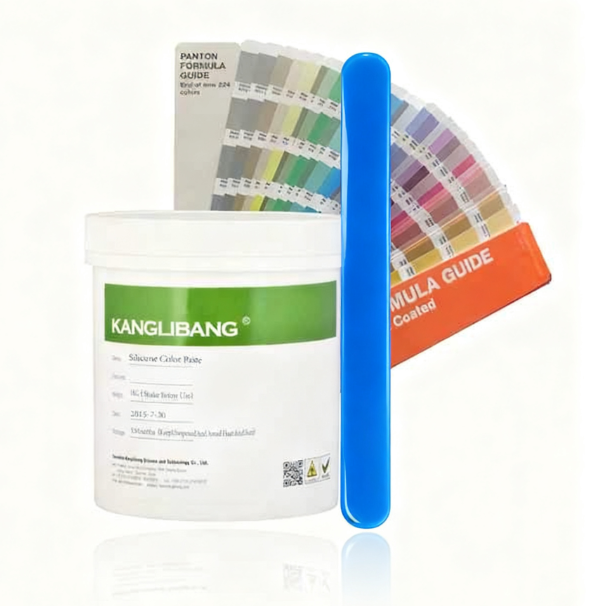
This is the most widely adopted solution for mass silicone manufacturing. KANGLIBANG silicone color paste is pre-modified with silicone carrier, with excellent dispersion for peroxide-cured solid silicone and platinum-cured liquid silicone. It perfectly matches silicone molecular structure to avoid agglomeration and color migration fundamentally.
Simple steps:
- Calculate weight ratio: prepare silicone base material, standard addition ratio 1%–5% by total silicone weight (1%–2% for light colors, 3%–5% for dark saturated colors)
- Add color paste into silicone gradually, mix fully via two-roll mill or vacuum mixer until no visible pigment particles
- Add curing agent and proceed with normal vulcanization molding process
- Complete color inspection after full curing to confirm uniform shade
After adopting matched silicone color paste, you can get consistent batch-to-batch color, support Pantone color matching customization, no blooming after long-term high-temperature aging.
Note: Do not mix color pastes from different brands randomly; perform small trial mixing before mass production to avoid incompatibility reaction.
Method 2: Optimize mixing & feeding process (For existing color paste improvement)
If you need to keep your current color paste formula, adjust mixing operation to reduce uneven coloring risk.
Advantages: No extra material cost, quick adjustment for existing production line
Disadvantages: Cannot solve inherent incompatibility issues fundamentally, color stability is limited
Operation tips: Divide color paste into 2–3 portions to add step by step, extend high-shear mixing time properly, avoid too fast feeding causing local pigment accumulation.
Method 3: Pre-color matching trial before mass production (For high-precision color order)
For customer orders requiring strict Pantone color tolerance, make small test samples first to confirm shade before bulk mixing. Adjust color paste proportion or blend multiple color paste tones to meet target Pantone number, avoiding large batch waste caused by color deviation.
IV. Pro tips to avoid coloring failure
- Do not exceed maximum 5% addition ratio: Excessive color paste will reduce silicone tensile strength, elongation and affect curing completeness
- Store color paste properly: Keep unopened paste in cool, shaded & dry environment, shelf life 6 months; stir thoroughly before use if sediment appears after long storage
- Confirm curing system matching: Select color paste formulated for platinum cure LSR or peroxide cure solid silicone respectively, cross-use may lead to curing inhibition
- Avoid direct UV exposure for finished colored silicone products long-term if you do not use UV-resistant grade color paste
With these standardized coloring solutions, you will effectively eliminate silicone streaking, color migration and batch color difference problems. For stable, high-precision silicone coloring production, start with professional silicone color paste formula first, and you will see obvious improvement in yield rate.