
Email: sales@bondsil.com
Tel:+86 - 0755 2105 3189
Addr: H Building ,Xinwei The 3rd Industrial Park,Dalang Street,Longhua New District , Shenzhen City ,Guangdong Province ,China

How to solve the problem of silicone adhesive double-sided tape being difficult
29 May 2026
Silicone products won't stick to double-sided tape? These 3 methods will finally solve the 'won't stick' problem
I. Have you ever run into this frustrating situation?
You carefully make a silicone phone case, silicone foot pad, or silicone sealing strip, then try to attach it with double-sided tape – only to have it fall off after half a day with the gentlest tug. You try several "high-tack" tapes, but nothing works. Don't blame the tape just yet. The real issue is likely the silicone itself.
II. Why is silicone so difficult to bond?
Silicone inherently has low surface energy and hydrophobic properties. Its surface energy is typically only 19–24 dyne/cm, while ordinary double-sided tape requires at least 30 dyne/cm for a strong bond. In simple terms: a silicone surface is like a non-stick pan – the adhesive simply cannot grip it.
On top of that, silicone often contains uncrosslinked low-molecular-weight silicone oils that continuously migrate to the surface, further degrading adhesion. This is why a bond might feel secure at first but starts to lift after a few days.
III. Practical solutions – proven to work
Method 1: Silicone primer (surface promoter)
This is the most reliable and widely used method. A silicone primer acts as an intermediary layer, modifying the surface polarity and significantly increasing surface energy, allowing double-sided tape to truly adhere.
Simple steps:
1. Clean the silicone surface thoroughly with alcohol and a lint-free cloth (removing mold release agents and silicone oils)
2. Apply a thin, even coat of silicone primer and let it air-dry for 3–5 minutes
3. Apply the double-sided tape and press firmly to ensure contact
4. Allow 24 hours for maximum bond strengt
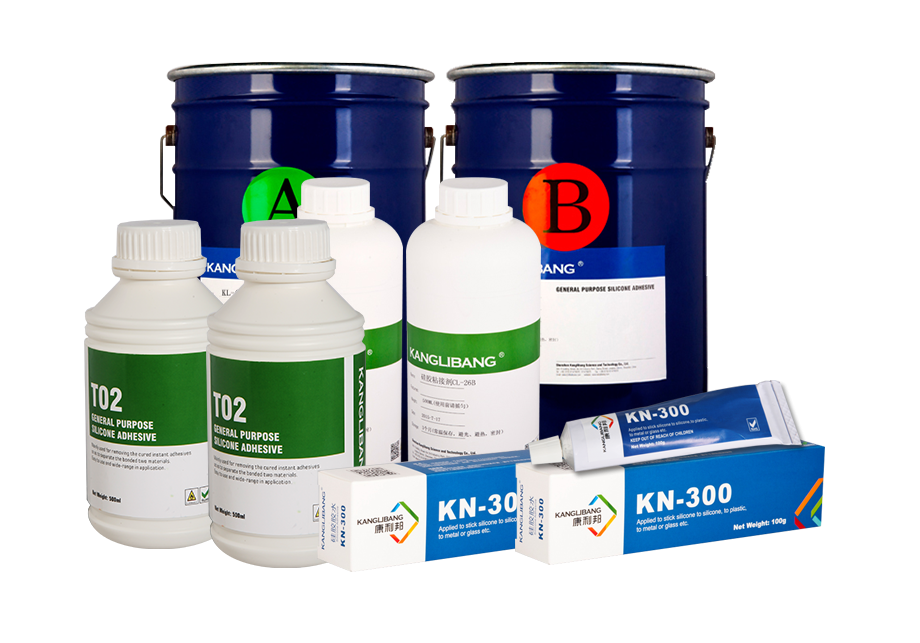
After priming, ordinary acrylic tapes or 3M tapes will bond securely – often becoming nearly impossible to peel off. Kanglibang treatment agent is effective and easy to use. Click to learn more.
Note: Primer is volatile. Use it in a well-ventilated area and avoid skin contact.
Method 2: Flame treatment (suitable for batch production)
For factory or mass‑production silicone parts, flame treatment is an option. A high-temperature flame is passed quickly over the silicone surface, instantly oxidizing the molecular layer and creating polar groups.
Advantages: high efficiency, no chemical residues.
Disadvantages: requires specialized equipment, and improper operation can damage the workpiece. Not recommended for home DIY or small workshops.
IV.Pro tips to avoid failure
1. Don't apply tape immediately after wiping with alcohol: residual alcohol or moisture weakens adhesion. Wait 1–2 minutes after cleaning.
2. Don't skip the pressure step: after applying the tape, press firmly with your fingers or a roller to ensure full contact and remove air gaps.
3. Don't stress the bond too soon: most adhesives need time to cure. Avoid heavy loads for at least 24 hours.
With these methods, you'll never have to worry about silicone products "delaminating" again. Next time you face this issue, try starting with a primer – you'll be surprised by the results.