
Email: sales@bondsil.com
Tel:+86 - 0755 2105 3189
Addr: H Building ,Xinwei The 3rd Industrial Park,Dalang Street,Longhua New District , Shenzhen City ,Guangdong Province ,China

How to Solve the “Debonding” Problem in Silicone-to-Metal Overmolding? Have You
17 Jun 2026
In industries like automotive, electronics, home appliances, and medical devices, the combination of metal and silicone is becoming increasingly common—from silicone seals around engine components, waterproof overmolding on electronic parts, non-slip grips on cookware handles, to medical instrument handpieces. Silicone-overmolded metal is everywhere.
Yet many manufacturers face a recurring nightmare: the silicone layer doesn't bond firmly to the metal after overmolding—it peels off.
The product comes out of the mold, and with a light tug, the silicone separates from the metal. Or it passes initial inspection, but after thermal cycling, humidity exposure, or vibration testing, bubbles and delamination appear. Seals fail, structures loosen, customers complain, and batches are scrapped. Poor adhesion doesn't just waste materials—it damages your reputation and your bottom line.
I. Why Won't Silicone and Metal 'Stick'?
To fix the problem, you have to understand its root causes. Poor bonding between silicone and metal is usually due to:
1. Surface energy mismatch.
Metal has high surface energy, but silicone is a low‑surface‑energy material. It struggles to wet and penetrate the metal surface effectively, resulting in weak interfacial forces. In simple terms, silicone molecules can't 'grip' the metal.
2. Surface contamination.
Residual oils, oxides, release agents, and other contaminants on the metal surface directly block the bonding interface, leading to adhesion failure.
3. Lack of chemical bonding.
If no primer or adhesion promoter is used, the silicone relies only on weak physical adsorption to stick to the metal—far below the strength required for industrial applications.
4. Coefficient of thermal expansion (CTE) mismatch.
Silicone and metal expand and contract at different rates when heated or cooled. The internal stress generated during temperature changes can cause the interface to separate.
II. From ‘Won't Stick ’ to ‘Won't Peel Even with a Knife’—The Key Is a Primer
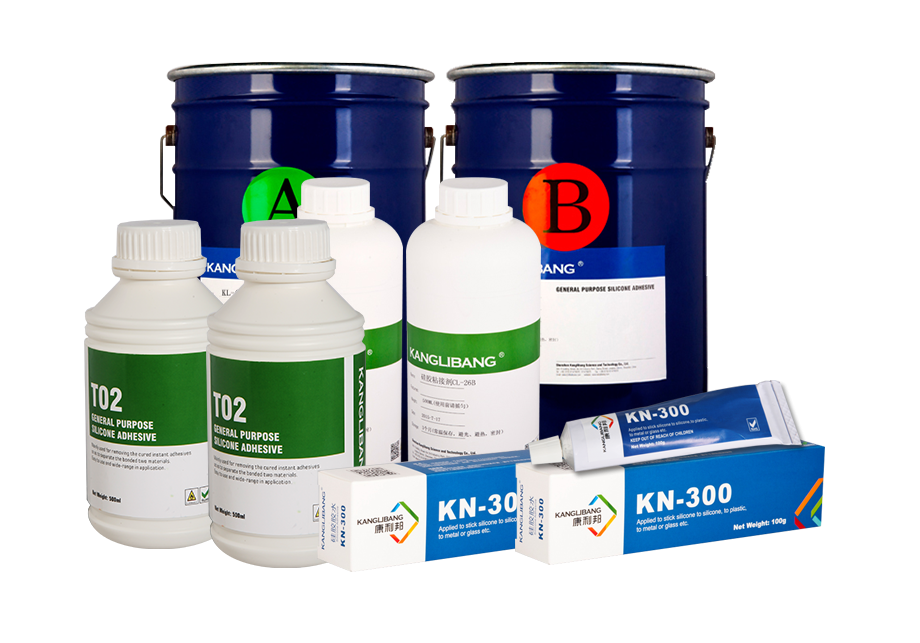
The core solution to all these issues is to build a 'transition bridge' between the metal surface and the silicone—a dedicated primer (adhesion promoter) .
The primer works on a straightforward principle: it contains special reactive ingredients that penetrate the microscopic pores on the metal surface and form strong chemical bonds with the metal substrate. At the same time, during heat‑curing (vulcanization), the primer's molecular chains cross‑link with the silicone molecules, creating covalent bonds. This effectively creates a 'molecular‑level bridge' between two materials that would otherwise be incompatible.
Our company's silicone‑to‑metal overmolding primer was developed specifically to solve this industry‑wide challenge. It uses an advanced silane‑polymer formulation that forms a dense 'transition adhesive film' on the metal surface. This film not only anchors tenaciously to the metal (with an adhesion rating of 0, the highest level), but also chemically bonds with the silicone molecular chains during vulcanization—fundamentally improving interfacial adhesion strength.
III. Three Simple Steps to Solve Your Overmolding Problems
Our primer is easy to apply and requires no complex equipment. Just three steps:
Step 1: Clean the metal surface.
Thoroughly remove oil, dust, and oxides using alcohol or acetone.
Step 2: Apply the primer.
Brush, spray, or dip‑coat the primer evenly onto the metal surface, aiming for a dry film thickness of 5–10 μm.
Step 3: Dry and then vulcanize.
Allow to air‑dry for 0 minutes at room temperature, or speed up drying at 110°C-130°C for 5-15 minutes. Then proceed with your standard heat‑curing (vulcanization) process at 160–200°C for 5–10 minutes.
IV. Hard Data That Speaks for Itself
In professional tests, silicone‑to‑metal bonded parts treated with our primer achieved peel strengths exceeding 10 MPa. Even after thermal cycling from ‑40°C to 150°C, or under high‑humidity and vibration conditions, adhesion retention remained above 90%. One customer reported that after switching to our primer solution, the rejection rate for silicone‑metal adhesion dropped from over 10% (with traditional methods) to below 0.5%—dramatically reducing rework and scrap.
Automotive: Our primer has been successfully used for bonding silicone insulation layers to brake pads and silicone sealing boots to metal engine components.
Electronics: It is ideal for overmolding silicone protective boots on metal sensor housings and silicone sealing rings around metal connector pins.
Home Appliances: It secures silicone sealing rings to metal heating plates in rice cookers and silicone non‑slip pads to metal soles of steam irons.
Medical Devices: The primer is RoHS‑compliant and can be used in sensitive applications such as silicone grips on metal connectors for rehabilitation equipment.
V. Conclusion
The 'debonding' headache in silicone‑to‑metal overmolding is not unsolvable. Choosing the right primer is more than half the battle. If you are struggling with poor adhesion between silicone and metal, please contact us for technical support and sample trials—let us help you eliminate adhesion as a production bottleneck.